selestium modular reset + new modular accessories coming
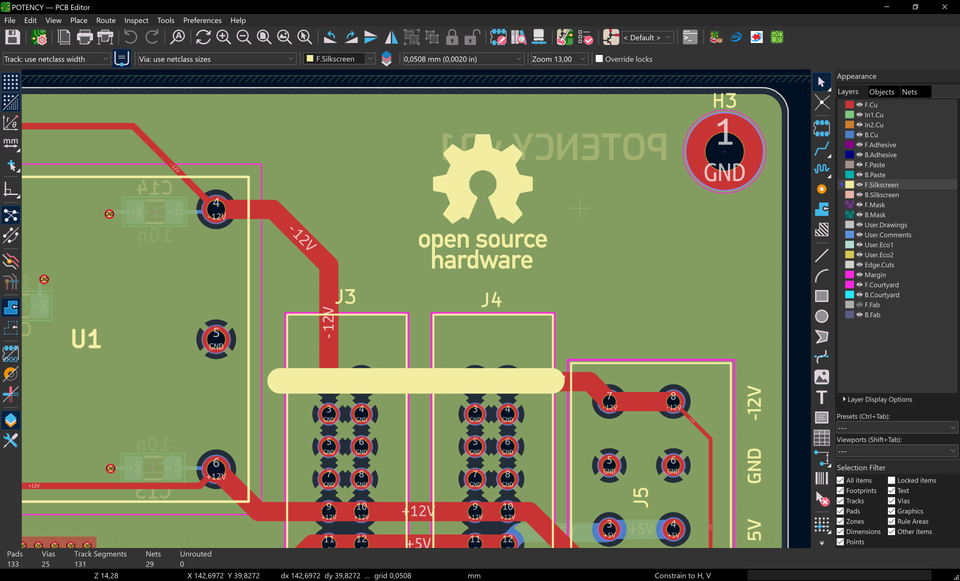
Dear modular lovers,
Over the past few months as I have been developing, refining, and exploring the future path of selestium modular, I've decided what is needed is a reset-of-sorts, and so through this e-mail I'm sharing with you all what I see for the future and my thoughts on doing these things in a year-of-messiness, 2026.
This might be a bit long, so for the impatient: selestium modular will be focusing on developing modules that allow for microtonal expression, estoteric interfaces, and material interactions that don't just involve metal and PCBs. To that end, some new modular accessories are coming late August that combine contemporary and old ways of working with materials.
I began this project in line with some of my earlier artwork practices that I do under the name of the tranxxeno lab. To that end, I wrote a rather long backstory to selestium modular (which can be read here) involving future archaeology, cosmic viewing, and letters. I tried to stay "in character" in the early days of the business, but over time I have found it less and less useful. While I still hew to the ethos of that story, I won't be making it the focus and the base of the business anymore.
Instead, going forward, I will be focusing on three main areas:
Microtonal expression: I find myself quite frustrated by not having the ready ability to load and work with microtonal scales within the modular system. Yes, almost every quantizer or quantized VCO has a pre-defined set of microtonal scales that one can use, but they're not based on the various standards that exist within the xenharmonic community and the decades of people who have been exploring tuning systems and using software such as Scala. (Yes, I know that there are some modules that support Scala files, but there are not many at all.) I already have at least one module in beta (and which I used in a sound art installation, Quanto Canto, and have used in a few public performances) that has this feature built-in, and I am hoping to be able to release that module in the not-distant future. Others modules that either make pitches (like sequencers) or are VCOs will support Scala files natively.
Estoeric interfaces: I've already begun this on a very basic level with my module QUIVERER (M5). Other modules in-development carry this forward, and also enable access to other, aetheric aspects of our world.
Different material interactions: I trained extensively as a violinist and as a violist earlier in my life. I miss the feel of those instruments--the wood, the shape, the feel of a bow-on-string. I yearn for a different material interaction within the modular. While a modular system is not an acoustic instrument--and nor should it try to be--I think we can work to incorporate other tactile qualities--wood, stone, etc--into the modular system. To that end, I am in the research-and-development stage around some possibilities.
Making electronic modules--and the need to rely on far-flung supply chains to do so--is somewhat of a difficult, confusing, depressing, harmful endeavor in 2026 while I at the same time watch the world burn, literally and metaphorically. To that end I aim to develop my products inspired by the practices of permacomputing. If you haven't come across this term before, I highly recommend reading more about it, especially regarding some of the principles. For selestium modular, this means:
-
An extremely careful analysis and choice around what chips I use. I spend a lot of time trying to ensure that that the parts I use in my boards have long-term manufacturer support[1], can be repaired relatively easily (so little-to-no extremely tiny parts[2]), and do not use extremely rare or esoteric chips. I want people to be able to repair my products 50-100 years from now, if necessary. There is no reason why the devices we make today cannot still be working 100 years from now, if they are designed appropriately.
-
All products are open-sourced. All hardware schematics, PCB designs, and firmware are available online: https://gitlab.com/selestium_modular. I will also be making a self-hosted copy of this repository in the near-future. Importantly, I license these works under either a strongly reciprocal open hardware license (CERN-OHL-S) or the GPLv3. This means that anyone can learn and build-off of this work...but they are required to give back to the community in the same way. I do not want others to take from my work and then not give back; these licenses aim to make that a legal requirement. I am trying to design my more complicated modules in a way that people could easily write alternative firmwares for them, to enable them to do whatever they might like. While I might see the particular layout of controls doing one thing, others could see the same layout as useful for something else. This is of course not a new idea in modular, but I think it's an important one to state from the outset.
-
Products are designed to be as accessible as possible. I've been thinking about this a lot over the past few years, and I'm really glad that Jeremy from Red Means Recording Modular raised this in a recent video (see https://www.youtube.com/watch?v=qcgyGgePXpw). Eurorack does have an accessibility problem. I aim to design my modules in a way that don't require shift keys, menu diving, etc. I will be using larger knobs and more space in future designs. I'm thinking about how to subtly include tactile information regarding knob, switch, slider, and jack identification on the front panel. I think all designers can get better at this. Because all of us, if we are lucky to live to an old age (and perhaps before old age), will require some form of accessibility accommodations someday. Why don't we build it into our modules right now?
-
No generative AI is ever used. I have not, do not, and will not, use generative AI in the production of these modules. While the world burns, this is the least I (and you) can do. One of the permacomputing principles is the idea of saying no, of refusal, of not doing. We do have that choice; we do have that capability. Use it, please. To quote from the permacomputing principles (all emphasis theirs):
The history of computing is deeply intertwined with capitalism and militarism. From playing a role in warfare and geopolitical power struggles to driving the automation of labor, computing has significantly contributed to the increased use of resources and fossil energy. The latest example of this trend is the construction of hyperscale data centers for running generative AI. Despite the promise of increased efficiency, the Jevons Paradox applies: higher efficiency tends to lead to greater resource use. Efficiency is often presented as a technical solution to a political decisions about how and why we use computing —without questioning the extractive business model.
Curbing demand through refusal has proven to be one of the most effective ways to reduce computing’s harm to people and the planet, and that's where the value of 'not doing' comes in. By observing and questioning what is truly needed, we bring attention to the broader issues:What is necessary? Who benefits? Who is harmed? And what are the impacts on the human and more-than-human environment?
While developing these ideas over the past few months, I have also been exploring how to incorporate, into selestium modular, my new practice of hand tool woodworking. Doing woodworking primarily through hand tools has been a wonderful experience that brings you extremely close to the material qualities of wood: how it to responds to planing, how smooth a surface can be, how the marks of working on the piece leave traces that are only found when something is worked by hand.
As such, I've developed a few accessories for your studio that combine CNC machining with hand tool finishing[3]. Any of you who have used a CNC to cut wood know that what comes out of the CNC needs a lot of cleanup. And that's where the hand tools come in. I use a plane, spokeshave, and files to finish the surface, adding subtle roundovers that show the mark of the hand. I use a tung oil finish and a shop-made tung oil pastewax (made out of tung oil and beeswax) to ensure that the piece is protected, but without using a finish that might be harmful to you or the environment.
I'm sharing the first image of one of these items in this newsletter.
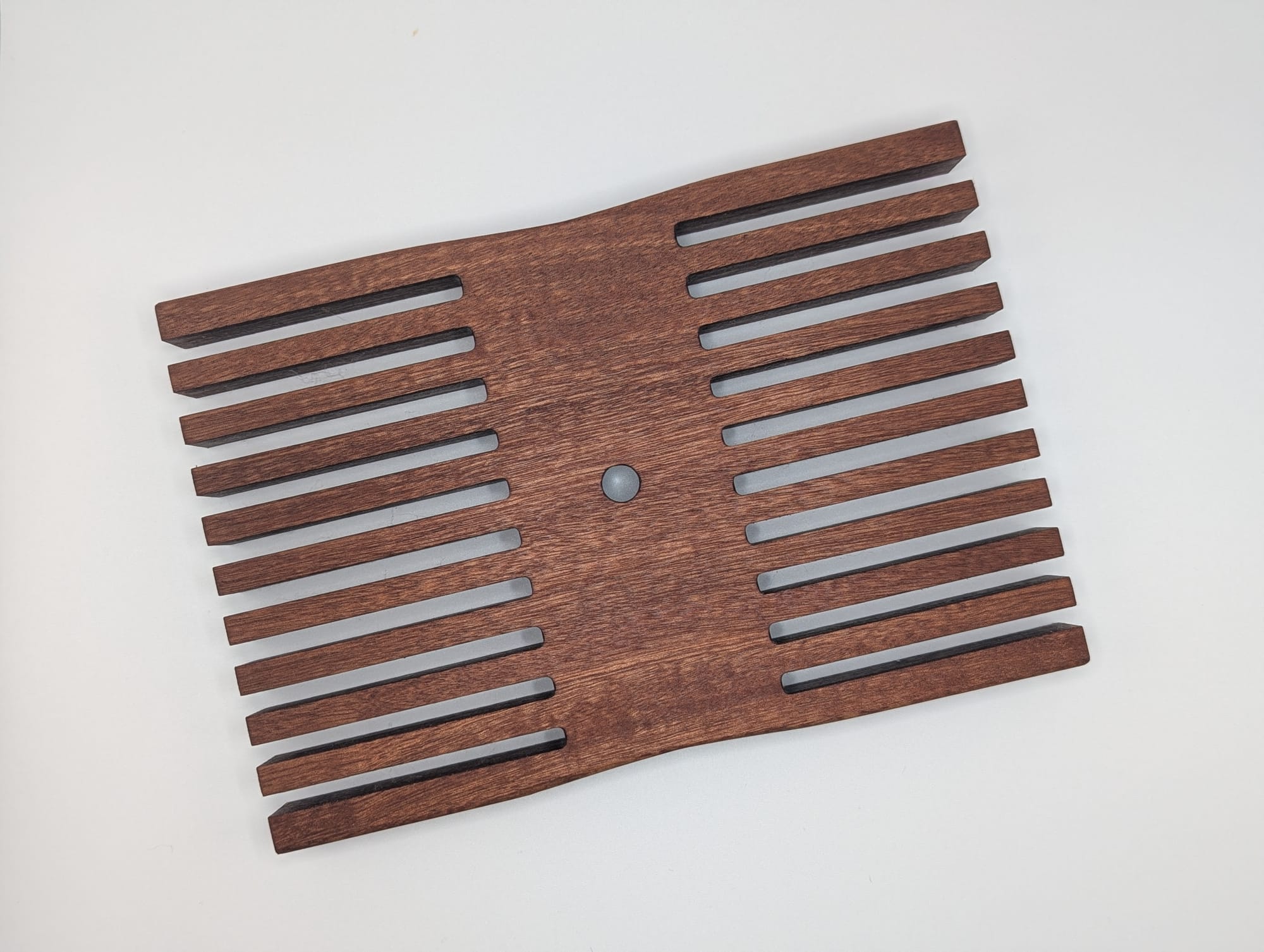
An elegant, solid hardwood cable hanger for your studio. No sandpaper is used on the surface, which means it is extremely smooth from the cutting action of the handplane. This one is made out of sapeli I had leftover from an earlier project (the aforementioned Quanto Canto). But it can be made out of other hardwoods as well--elm, beech, maple, etc. The cable hanger has a few variations, including single-sided hangers, hangers with wider slots for XLR and TRS cables, etc.
More details will be forthcoming in August, along with some background video of the making process...it's more involved than you might think!
And thus I will end this letter now. Thanks for staying with me to the end. I hope some of what I've written resonates with you, that perhaps you've learned something new about permacomputing, and that you'll be interested in some of the things I will be releasing soon. As always, any questions or thoughts, please send them my way.
Until next time,
Adriana
I've standardized on mainstream STM32 ARM microcontrollers for my digital modules. Right now STM promises support for the models I'm using for at least another 10 years, which is one of the longer time-frames in the industry. ↩︎
I don't use passive parts smaller than 0805, which are the smallest packages I feel comfortable soldering by hand. Some of the ICs I use have to be TQFP size, which is right at the limits of my hand-soldering ability. I refuse to use any BGAs. ↩︎
Yes, I know using a CNC doesn't nicely align with doing things solely by hand. Yet for the pieces I am making, I could never charge the amount it would cost for me to make them entirely by hand. Thus the CNC is used to get the rough shape, and the hand tools are used to bring that rough shape to completion. ↩︎